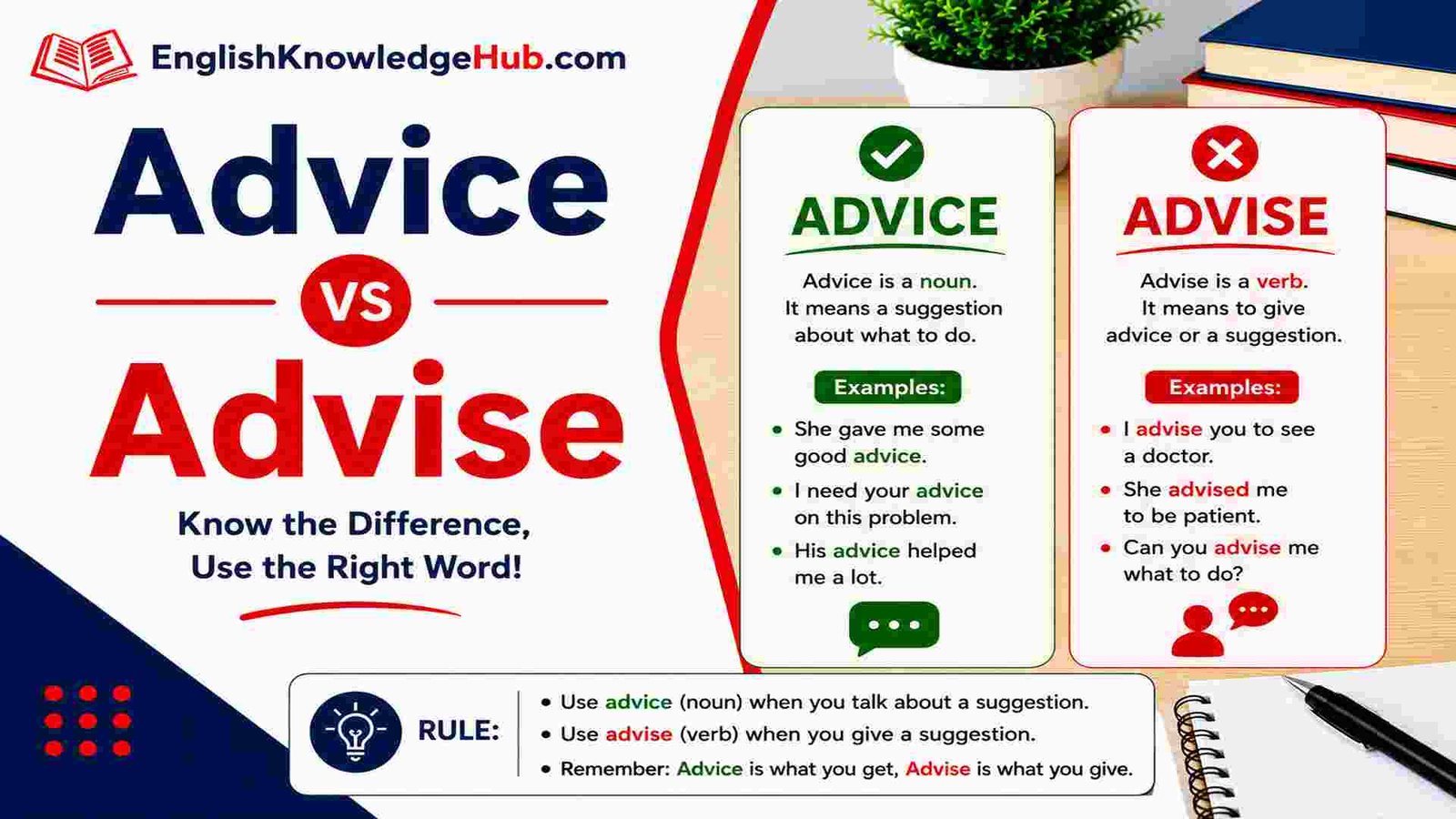
Advice and advise are related, but they have different grammar jobs. Advice is a noun meaning a recommendation, opinion, or guidance you receive or give. Advise is a verb meaning to give that guidance or information. You advise a person, but you give them advice.
In this article, you’ll learn how Advice vs Advise differ in meaning, pronunciation, sentence structure, and word forms, plus common problems such as an advice, advices, please advise, and advise vs recommend. Merriam-Webster’s Advice vs Advise usage guide confirms that advise is the verb and advice is the noun.
The Core Rule: Advice Is the Thing; Advise Is the Action
Think of advice as the information or recommendation itself. “Her advice was helpful.” “I need some advice.” “We followed the doctor’s advice.”
Advise describes the act of giving guidance. “She advised me to wait.” “The lawyer advised the client carefully.”
If you can put the or some before the word, you probably need advice. If someone is doing something to or for another person, you probably need advise.
Pronunciation Gives You a Useful Clue
The final consonant sounds are different. Advice ends with an s sound, while advise ends with a z sound.
That difference mirrors other English noun-verb pairs. Saying the sentence aloud can help when your eye gets stuck on the nearly identical spelling.
Advice Is an Uncountable Noun
This is one of the most important learner points. In standard English, advice is normally a mass or uncountable noun. That means we do not usually say an advice or advices.
Instead, say “some advice,” “a piece of advice,” “two pieces of advice,” or “a bit of advice.”
Incorrect: She gave me an advice.
Correct: She gave me some advice.
Correct: She gave me a piece of advice.
This is not just a spelling issue. Even writers who know advice is the noun often make the countability mistake.
Natural Verbs That Go With Advice
English commonly says give advice, offer advice, provide advice, ask for advice, seek advice, get advice, and follow advice.
“I asked my teacher for advice.” “The consultant provided practical advice.” “She followed her doctor’s advice.”
Learning these combinations makes your writing sound much more natural than memorizing the definition alone.
How to Use “Advise”
Advise is a regular verb: advise, advises, advised, advising.
A very common pattern is advise + person + to + verb: “I advised him to wait.” “The accountant advised us to keep the receipts.”
You can also use advise + -ing when no person is named: “We advise arriving early.” In formal contexts, you may see “The report advises caution” or “Doctors advise against smoking.”
“Please Advise” in Emails
Please advise is common in business emails, especially when asking someone to tell you what to do next or provide information.
“The supplier has changed the delivery date. Please advise.” This is grammatical, but it can sound abrupt if the relationship is formal or sensitive.
Often, a more specific request is warmer and clearer: “Please advise me on the next steps,” “Could you let me know how you would like me to proceed?” or “Please let me know which option you prefer.”
So the phrase is correct, but good communication depends on tone as well as grammar.
“Please Be Advised” Means Something Different
Please be advised that… does not ask for advice. It means “please be informed that…” and is common in formal notices.
“Please be advised that the office will close at 4 p.m.” The writer is giving information, not requesting guidance.
This phrase is grammatically correct but often formal. In everyday business writing, “Please note that…” may sound simpler.
Advise vs Recommend
Advise often focuses on guidance given to a person. Recommend can suggest a person, product, action, or choice as suitable.
“I advise you to back up the files” gives guidance directly to someone. “I recommend this backup tool” suggests a particular option.
The verbs overlap in many situations, but their sentence patterns differ. We say “I advise you to go” and “I recommend going.” “I recommend you to go” is less natural in most standard varieties.
Advice vs Suggestion
A suggestion can be any idea offered for consideration. Advice usually aims to help someone decide what to do.
“Let’s meet at 8” can be a suggestion. “You should leave earlier because traffic is heavy” is advice.
In practice, the meanings can overlap, but advice more strongly implies guidance.
Common Mistakes
Incorrect: Can you advice me?
Correct: Can you advise me?
The sentence needs a verb.
Incorrect: Thank you for your advise.
Correct: Thank you for your advice.
The sentence names the guidance, so it needs the noun.
Incorrect: He gave me three advices.
Correct: He gave me three pieces of advice.
Advice is uncountable in standard English.
Incorrect spelling: The doctor adviced me to rest.
Correct: The doctor advised me to rest.
The past tense of advise is advised.
How the Pair Works in Real Contexts
Everyday: “Can I ask you for some advice?” “I’d advise you to wait until tomorrow.”
Workplace: “Our legal team advised us to revise the clause.” “Their advice helped us avoid a delay.”
Academic: “Students are advised to cite all sources.” “The supervisor’s advice improved the research plan.”
The grammar role stays consistent even when the level of formality changes.
A Simple Replacement Test
If you can replace the word with guidance, choose advice. If you can replace it with recommend or tell someone what would be wise, choose advise.
| Word | Grammar job | Example |
|---|---|---|
| advice | noun | I need some advice. |
| advise | verb | I advise you to wait. |
| advised | past tense / participle | She advised me yesterday. |
| advising | -ing form | He is advising the team. |
This noun-versus-verb approach also helps with pairs such as Propose or Purpose, where identifying the word’s job quickly narrows the choice.
Frequently Asked Questions
Is advice a noun or verb?
Advice is a noun.
Is advise a noun or verb?
Advise is a verb.
Can I say “an advice”?
Not normally in standard English. Say some advice or a piece of advice.
Is “advices” correct?
Not for ordinary recommendations or guidance. Use pieces of advice if you need to count them.
Is “please advise” correct?
Yes, especially in business communication, though a more specific request may sound friendlier and clearer.
How do you pronounce advice and advise?
Advice ends with an s sound; advise ends with a z sound.
Final Takeaway
For Advice vs Advise, remember that advice is the guidance and advise is the action of giving it. Advice is uncountable, so use some advice or a piece of advice, not an advice or advices. Once you identify whether the sentence needs a noun or a verb, the spelling becomes straightforward.
For more practical grammar and vocabulary lessons, explore EnglishKnowledgeHub.com.
