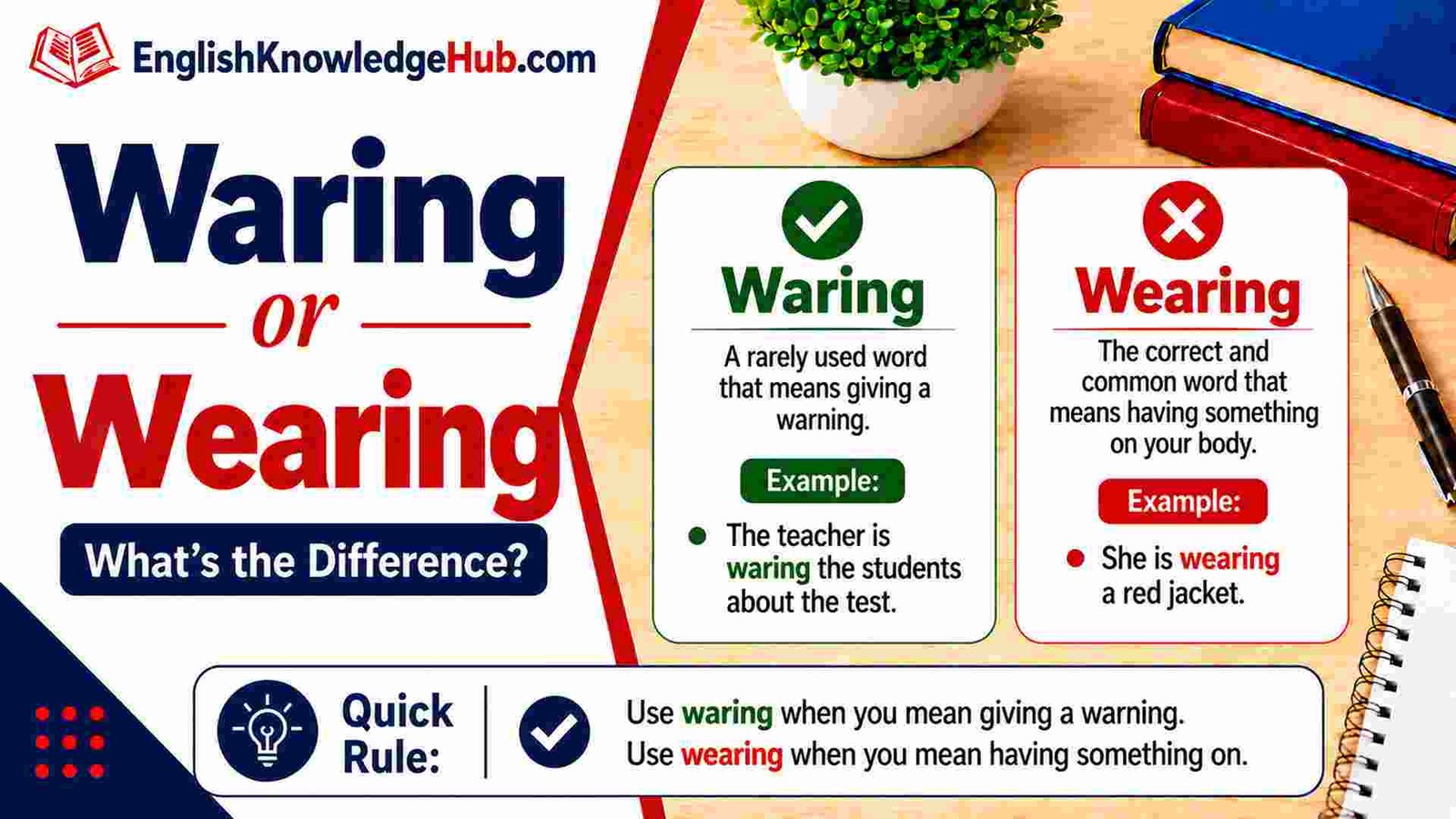
Waring vs wearing is usually easy to settle: wearing is the correct word when you mean having clothes, shoes, glasses, jewelry, or another item on your body. Waring is not an alternative spelling of wearing. It can exist in rare uses connected with the verb ware, but most modern writers will almost never need it.
If you typed “She is waring a jacket,” the missing e changes the word. Write “She is wearing a jacket.” This guide explains the spelling, the grammar behind wearing, the unusual status of waring, and a few nearby words that often create extra confusion.
The Fast Answer You Can Use Right Away
| Word | Standard? | What it means | Example |
|---|---|---|---|
| Wearing | Yes | The -ing form of wear; also an adjective meaning tiring | Mina is wearing a silver watch. |
| Waring | Rare | An uncommon form connected with rare or old senses of ware | Not normally used in everyday English |
| Warring | Yes | Being at war or in serious conflict | The warring sides began peace talks. |
Cambridge records wear as the verb used for having clothing or jewelry on the body, with wore as its past tense and worn as its past participle. You can check the full entry in the Cambridge Dictionary.
Why “Wearing” Keeps the E
A learner may look at verbs such as make → making and write → writing and expect wear to lose a letter too. But wear does not end in a silent e. The letters e-a are already part of the base spelling wear. To form the present participle, we simply add -ing:
wear + ing = wearing
That is why waring cannot replace wearing in a sentence about clothes.
Compare:
- I wear a cap when I work outside.
- She wears safety glasses in the lab.
- We wore formal clothes to the dinner.
- He has worn that coat for three winters.
- They are wearing matching shirts today.
If spelling changes around verb endings often catch you out, our guide to Useing or Using explains another common -ing spelling problem.
What Does “Wearing” Mean?
Most often, wearing describes something a person has on the body. It is not limited to clothing. You can wear glasses, perfume, a badge, a seat belt, makeup, a hearing aid, or even a smile.
Daily conversation
- Are you wearing your new shoes today?
- I’m wearing a sweater because the office is cold.
- Why is Omar wearing sunglasses indoors?
Workplace and academic writing
- All visitors must be wearing an identification badge inside the secure area.
- The researcher recorded whether each participant was wearing protective equipment.
- Staff members wearing headsets can answer calls while moving around the room.
Wearing can also be an adjective meaning tiring or exhausting. Cambridge lists this adjective separately. A long, difficult day can be “wearing,” even though no clothing is involved. See the Cambridge entry for wearing for that use.
So, Is “Waring” Actually a Word?
This is where a simple spelling article needs a little care. Saying “waring is never a word” is too broad. Rare dictionary and historical uses of the verb ware exist, and waring may appear as its -ing form. Those uses are not the normal modern verb for putting on or having clothes on your body.
For practical everyday English, the rule is much easier: if your meaning is connected with clothes, accessories, appearance, or something carried on the body, choose wearing.
You may also see Waring as a surname or proper name. A person’s family name follows its own spelling and should not be “corrected” to Wearing.
Do Not Mix Up Waring, Wearing, and Warring
The extra r in warring matters. Warring comes from war, not wear. It describes groups, nations, ideas, or people engaged in conflict.
Wearing: The presenter was wearing a navy suit.
Warring: The warring factions finally agreed to meet.
Waring: Not the spelling you want in either sentence above.
A useful memory trick is to look at the base word. WEAR is still visible inside WEARing. If you can say “I wear it,” then the -ing form is “I am wearing it.”
Common Mistakes and Better Corrections
Incorrect: I am waring my school uniform today.
Correct: I am wearing my school uniform today.
Explanation: The sentence means “have clothing on,” so the verb comes from wear.
Incorrect: She was waring a gold necklace at the ceremony.
Correct: She was wearing a gold necklace at the ceremony.
Explanation: Jewelry can be worn, so wearing is the correct -ing form.
Incorrect: The two wearing kingdoms fought for years.
Correct: The two warring kingdoms fought for years.
Explanation: Here the idea is conflict, not clothing.
Incorrect: He is wearing that old jacket yesterday.
Correct: He wore that old jacket yesterday.
Explanation: The problem here is tense. Yesterday normally calls for the past form wore.
A Small Test That Works
When you hesitate over waring vs wearing, remove -ing and test the base verb.
“She is ___ a helmet.” → “She ___ a helmet.”
You would say “She wears a helmet,” so the continuous form must be “She is wearing a helmet.” This base-word check is quick, and it works better than trying to memorize the shape of the longer word.
The same habit can help with other spelling pairs. For example, Putting vs Puting shows why some verbs double a consonant before -ing.
Frequently Asked Questions
Is waring or wearing correct for clothes?
Wearing is correct. Write “She is wearing a dress,” not “She is waring a dress.”
Is “waring” a spelling mistake?
It is a spelling mistake when you mean the -ing form of wear. Rare uses related to ware and the proper name Waring are separate cases.
What is the past tense of wearing?
The base verb is wear, and its simple past form is wore. Example: “I wore my new boots yesterday.”
Is “worn” the same as “wearing”?
No. Worn is the past participle: “She has worn that dress before.” Wearing is the present participle: “She is wearing it now.”
What is the difference between wearing and warring?
Wearing usually relates to having something on the body. Warring relates to war, fighting, or serious conflict.
Can wearing describe something other than clothes?
Yes. People can be wearing glasses, jewelry, perfume, makeup, a badge, or a particular expression.
Final Takeaway
For the everyday waring vs wearing question, wearing is almost always the answer you need. It comes directly from wear, and the base spelling stays visible when -ing is added. Save warring for conflict, and treat waring as a rare form or proper name rather than a clothing word.
For more clear, practical explanations of tricky spellings and grammar choices, keep learning with EnglishKnowledgeHub.com.
