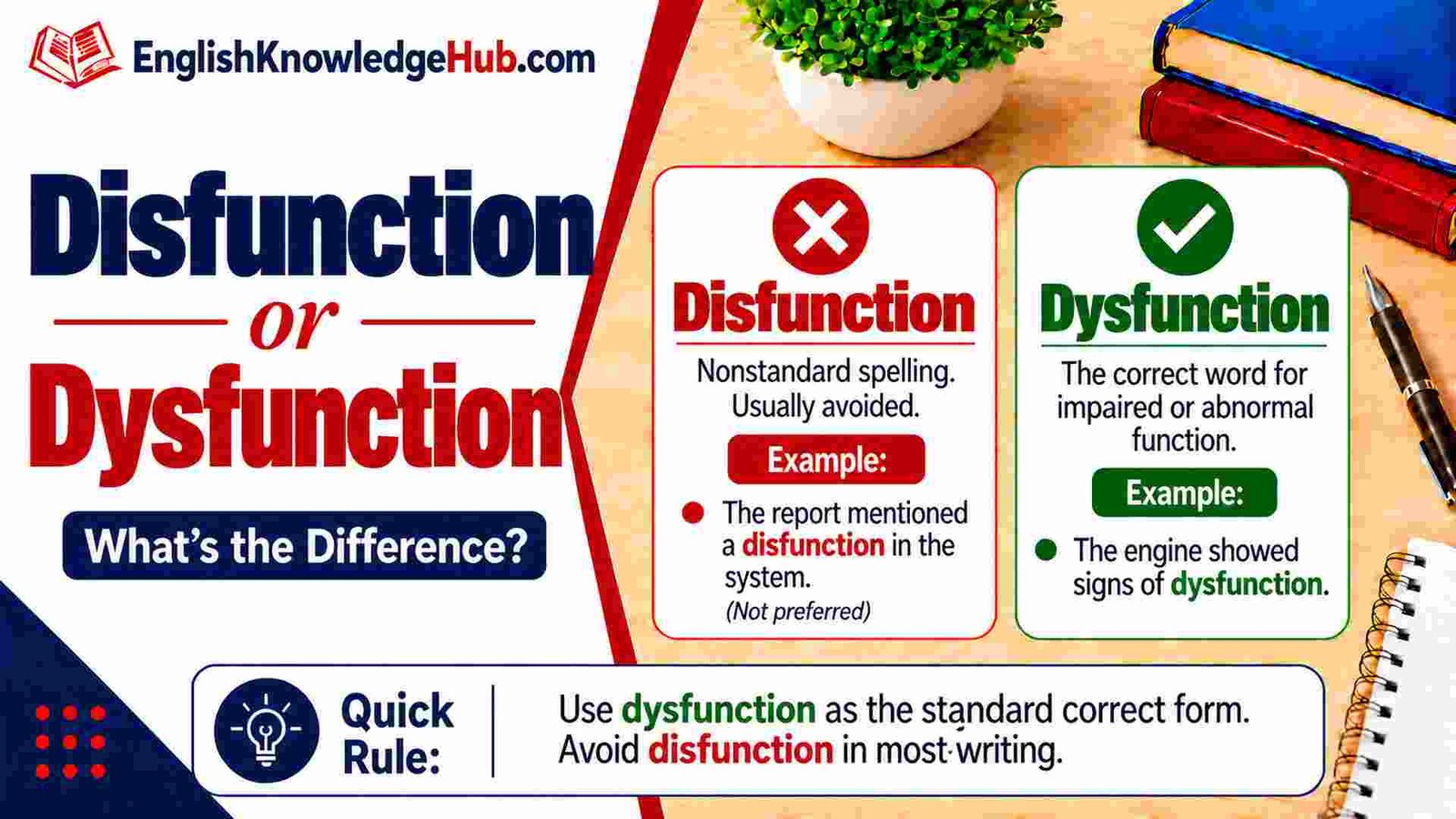
When choosing between Disfunction or Dysfunction, use dysfunction in normal English. Dysfunction is the standard and common spelling. It means that something is not working as it should. Disfunction can sometimes be found as a rare spelling, but most writers should use dysfunction. This guide explains the meaning, spelling, and correct use.
The two spellings look very close. That is why many people mix them up.
The easiest rule is simple:
Write dysfunction.
You may see disfunction in some places, but dysfunction is the spelling used most often in modern English.
Why Is Dysfunction the Better Spelling?
The word starts with dys-.
The prefix dys- can show that something is bad, hard, or not working in the normal way.
Then we have the word function.
A function is the job or work that something is meant to do.
Put them together:
dys + function = dysfunction
So, dysfunction means a problem that stops something from working in the right or normal way.
Here is a simple example:
The office has a lot of dysfunction because no one knows who should do each job.
The office is not working well as a group.
Is Disfunction Wrong?
This part needs a little care.
Disfunction is not completely made up. Some dictionaries record it as a much less common form of dysfunction.
However, that does not mean both spellings are equally good choices.
In normal writing, you should use:
dysfunction
You should use it in:
- school work
- emails
- reports
- articles
- workplace writing
- medical writing
- formal writing
So, when you are unsure about Disfunction or Dysfunction, choose dysfunction.
What Does Dysfunction Mean?
Dysfunction is a noun.
It means that a person, body part, group, system, or relationship is not working in a normal or healthy way.
The word can be used in many kinds of situations.
In the body
A body part may not work as it should.
Example:
The doctor found a small problem that could cause kidney dysfunction.
In a family
People in a family may have serious problems with trust, care, or communication.
Example:
Poor communication caused more dysfunction in the family.
At work
A team may have problems because people do not work well together.
Example:
The manager wanted to fix the dysfunction in the sales team.
In a system
A system may fail to do its job well.
Example:
The old rules created dysfunction in the school system.
The meaning stays close in all these examples.
Something is not working properly.
Disfunction or Dysfunction: Quick Comparison
| Word | Meaning | Usage |
|---|---|---|
| Dysfunction | Something is not working normally | Standard and preferred |
| Disfunction | Same basic meaning | Rare and less common |
The safest choice is easy to remember:
Use dysfunction.
Dysfunction and Dysfunctional Are Not the Same Form
These words are closely related, but they have different jobs.
Dysfunction is a noun.
It names the problem.
Dysfunctional is an adjective.
It describes a person, group, system, or thing that does not work well.
Look at these examples:
Dysfunction:
The team showed signs of dysfunction.
Dysfunctional:
The team became dysfunctional.
Here is another pair:
The family was dealing with dysfunction.
The family had a dysfunctional way of solving problems.
A simple trick can help:
Dysfunction = the problem
Dysfunctional = describes something with the problem
Easy Examples of Dysfunction
Here are some new examples from different parts of life.
Daily Conversation
- Their constant fights caused dysfunction at home.
- The family talked openly about the problems causing dysfunction.
- Poor planning created dysfunction during the trip.
Workplace Examples
- Bad communication caused dysfunction in the office.
- The new boss tried to reduce dysfunction between the two teams.
- Missing rules created dysfunction in the company.
Academic Examples
- The study looked at how sleep problems can lead to brain dysfunction.
- The paper explains how social dysfunction can affect a community.
- Researchers studied signs of memory dysfunction in older adults.
Formal Writing Examples
- The report found serious dysfunction in the payment system.
- The review showed that poor leadership caused organizational dysfunction.
- The committee created new rules to reduce administrative dysfunction.
Common Mistakes With This Word
Mistake 1: Using the rare spelling
Incorrect or less suitable:
The department has serious disfunction.
Correct:
The department has serious dysfunction.
Explanation:
Disfunction can appear as a rare form, but dysfunction is the normal spelling to use.
Mistake 2: Using dysfunction as an adjective
Incorrect:
The office is dysfunction.
Correct:
The office is dysfunctional.
Explanation:
Dysfunction is a noun. Dysfunctional is the adjective.
You can also say:
The office has a lot of dysfunction.
Mistake 3: Writing disfunctional
Incorrect or less suitable:
They have a disfunctional work system.
Correct:
They have a dysfunctional work system.
Explanation:
The normal adjective is dysfunctional, with dys-.
Mistake 4: Using dysfunction when malfunction sounds more natural
Less natural:
My printer has dysfunction.
Better:
My printer has a malfunction.
Explanation:
We often use malfunction for machines and devices. Dysfunction is more common for body systems, families, groups, organizations, and larger systems.
Dysfunction or Malfunction?
These words can have close meanings.
Both can describe something that is not working properly.
But we often use them in different places.
Malfunction is very common for machines.
Example:
The washing machine stopped because of a small malfunction.
Dysfunction is common for people, body systems, families, teams, and organizations.
Example:
Poor leadership caused dysfunction in the company.
Another example:
The illness may lead to liver dysfunction.
So, the words can be related, but one may sound more natural than the other.
Is Dysfunction Only Used in Medical English?
No.
Doctors use the word often, but it is not only a medical word.
You may hear phrases such as:
- kidney dysfunction
- liver dysfunction
- brain dysfunction
- sexual dysfunction
- family dysfunction
- social dysfunction
- workplace dysfunction
- organizational dysfunction
The word can describe almost any situation where something is not working in a healthy or normal way.
Is There a British and American Spelling Difference?
No important spelling difference exists here.
British English uses dysfunction.
American English also uses dysfunction.
You do not need to change the spelling for different English-speaking countries.
This makes the choice between Disfunction or Dysfunction much easier.
Use dysfunction in both British and American English.
How to Remember the Correct Spelling
Try this small memory trick:
DYS = Does Your System work?
If the answer is no, think of:
DYSfunction
It is only a memory trick, but it can help you remember the letters.
You can also connect the word with:
- dyslexia
- dysfunctional
- dysfunction
All three begin with dys-.
When Should You Use Dysfunction?
Use dysfunction when you want to name a problem in the way something works.
For example:
Body:
The test showed mild liver dysfunction.
Family:
Years of arguments caused dysfunction in the home.
Workplace:
Poor leadership created dysfunction in the team.
System:
The new process was designed to reduce dysfunction.
If you want to describe the thing itself, use dysfunctional.
The team is dysfunctional.
If you want to name the problem, use dysfunction.
The team has serious dysfunction.
A Fast Test
Still wondering about Disfunction or Dysfunction?
Use this quick test.
Do you mean a problem where something does not work normally?
If yes, write:
dysfunction
Do you want to describe something that does not work properly?
Write:
dysfunctional
Examples:
The system has dysfunction.
The system is dysfunctional.
That is the main rule you need.
Frequently Asked Questions
Is disfunction a word?
Yes, it can appear as a rare spelling of dysfunction. However, it is much less common. Use dysfunction in normal modern English.
Which is correct, Disfunction or Dysfunction?
Dysfunction is the standard and preferred spelling. It is the best choice for school, work, medical, and formal writing.
What does dysfunction mean in simple words?
It means that something is not working as it should.
Is it dysfunctional or disfunctional?
Use dysfunctional. It is the normal spelling of the adjective.
Example:
The team became dysfunctional after the manager left.
What is the difference between dysfunction and dysfunctional?
Dysfunction is a noun.
Dysfunctional is an adjective.
Example:
The group has dysfunction.
The group is dysfunctional.
Can dysfunction describe a family?
Yes. Family dysfunction means that there are serious problems in the way family members live, communicate, or treat one another.
Can dysfunction be used for the body?
Yes. Doctors may use it when a body part or body system is not working normally.
Example:
The tests showed kidney dysfunction.
Is dysfunction a formal word?
It is common in formal, medical, academic, and workplace English. It can also appear in normal conversation.
Final Rule to Remember
For Disfunction or Dysfunction, the spelling you should normally choose is dysfunction.
Disfunction may appear as a rare variant, but it is not the normal choice for modern writing. Use dysfunction when you name a problem with how something works. Use dysfunctional when you describe something that does not work properly.
Remember this simple pair:
Dysfunction = the problem
Dysfunctional = describes the thing with the problem
For more easy English spelling, grammar, and word guides, keep learning with EnglishKnowledgeHub.com.
